How to Match Discrete Transistors for Reliable Circuit Performance
Introduction
When building circuits that rely on paired or multiple transistors—such as differential amplifiers, current mirrors, or push-pull stages—you need the transistors to behave as identically as possible. Even two transistors from the same batch can have slightly different current gain (hFE) or saturation voltage, causing one device to carry more current than the other. This imbalance reduces efficiency and can lead to premature failure. While integrated circuits often include matched transistor pairs on a single die, discrete transistors require manual selection. This guide walks you through the process of matching discrete transistors so your circuits operate reliably and predictably.
What You Need
- Digital multimeter (DMM) with a transistor test function (hFE socket) or a dedicated transistor tester.
- Selection of transistors of the same type (e.g., 2N3904, BC547).
- Breadboard and jumper wires (if not using a socket).
- Resistors (1 kΩ and 10 kΩ) for testing VBE matching if your meter lacks hFE.
- Notebook and pen or spreadsheet to record readings.
- Labeling tape or marker to mark matched pairs.
- Antistatic wrist strap (recommended when handling sensitive transistors).
Step-by-Step Matching Process
-
Step 1: Determine the Matching Parameter
Before you start measuring, decide which parameter is critical for your circuit. In most cases, you need transistors with similar current gain (hFE) at the expected collector current. For differential pairs, base-emitter voltage (VBE) matching is also important. Saturation voltage matching may be required for switching applications. Refer to your circuit’s design notes to choose the right criterion.
-
Step 2: Prepare Your Measurement Setup
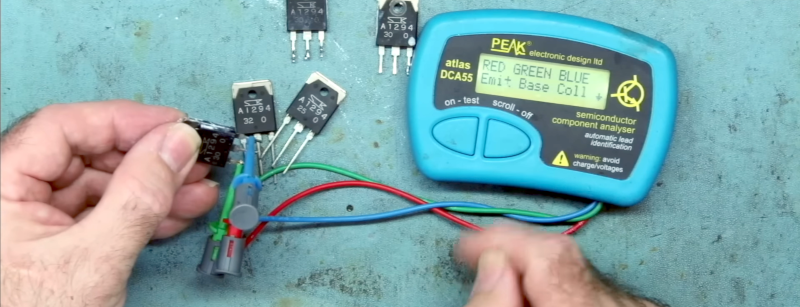
Set your multimeter to the hFE mode and insert each transistor into the correct socket (NPN or PNP). If your meter lacks this function, build a simple test circuit on a breadboard: connect a 10 kΩ resistor from the base to VCC (say 5 V), a 1 kΩ collector resistor to VCC, and measure collector voltage to calculate gain. Alternatively, use a dedicated transistor tester like the Peak Atlas DCA for convenience.
-
Step 3: Measure and Record hFE for All Transistors
Test each transistor at the same collector current (typical for your application). Write down the hFE value. For precise matching, repeat the measurement at two or three different current levels because gain changes with current. Use a consistent test environment—temperature and voltage should remain constant.
-
Step 4: Measure and Record VBE (If Required)
To match base-emitter voltage, use a constant base current (e.g., 10 µA) and measure VBE with a high‑impedance voltmeter. For a simple test, you can connect the base to +5 V through a 470 kΩ resistor, the emitter to ground, and measure voltage between base and emitter. Record VBE for each transistor.
Source: hackaday.com -
Step 5: Sort and Create Matched Pairs
After you have a list of hFE (and possibly VBE) values, sort them. Group transistors whose hFE values are within 5 % of each other. For VBE, look for differences less than 5 mV. Label each group with a sticker or marker. For critical circuits, you may need pairs that match both parameters.
-
Step 6: Verify Matching Under Load
Optional but recommended: Install your matched pair in a test circuit that simulates the actual load. Measure the collector currents of both transistors and confirm they are within 10 % of each other. If not, re‑evaluate your sorting. This step catches hidden mismatches caused by temperature or current nonlinearities.
Tips for Reliable Matching
- Temperature matters. Transistor parameters drift with temperature; let devices cool to room temperature before measuring. Avoid touching them with your fingers during tests.
- Use fresh batteries in your multimeter to maintain accurate readings, especially for low‑current measurements.
- Match more than two. Buy a batch of 10–20 transistors of the same type; you’ll likely find several close pairs.
- Resistor matching is similar. As mentioned in the original article, the same idea applies to resistors in bridge circuits: measure and pair units with nearly identical values (e.g., two 9.2 kΩ resistors from a 10 kΩ batch).
- Impedance matching is different. Don’t confuse transistor matching with impedance matching. The latter is about maximizing power transfer by matching source and load impedances—a separate concept.