Pushing the Limits: Extreme Cooling Unlocks Hidden Performance in Apple's MacBook Neo
Introduction
Mobile devices, despite their impressive portability and efficiency, suffer from a fundamental weakness: thermal throttling. Unlike bulky desktops or servers, laptops and tablets must operate at a fraction of their chip's true potential to prevent overheating. Apple's budget-friendly MacBook Neo, powered by the A18 processor derived from the iPhone, is no exception. Since its release, a fierce competition has emerged on benchmark leaderboards, with enthusiasts seeking to push this modest machine to its absolute limits. One notable contender, Salem Techsperts, briefly claimed the title of 'fastest MacBook Neo' and shared a detailed video of the process. The method? Aggressive, almost absurd cooling—a demonstration that sometimes, breaking free from design constraints requires drastic measures.
The Thermal Throttling Problem
At the heart of the issue is the A18 system-on-chip (SoC). In its standard configuration, the MacBook Neo operates at a modest power envelope—around 4 watts—to maintain safe temperatures within its slim chassis. Any sustained heavy load triggers thermal throttling, where the processor reduces its clock speed to avoid damage. This is a sensible design choice for a daily-driver laptop, but it leaves untapped performance on the table. Enthusiasts have long known that better cooling can release that hidden power. Simple upgrades, like replacing Apple's standard thermal paste with a high-performance compound, can yield noticeable gains. But for those seeking record-breaking speeds, far more extreme solutions are required.
The Cooling Arsenal: From Paste to Peltier
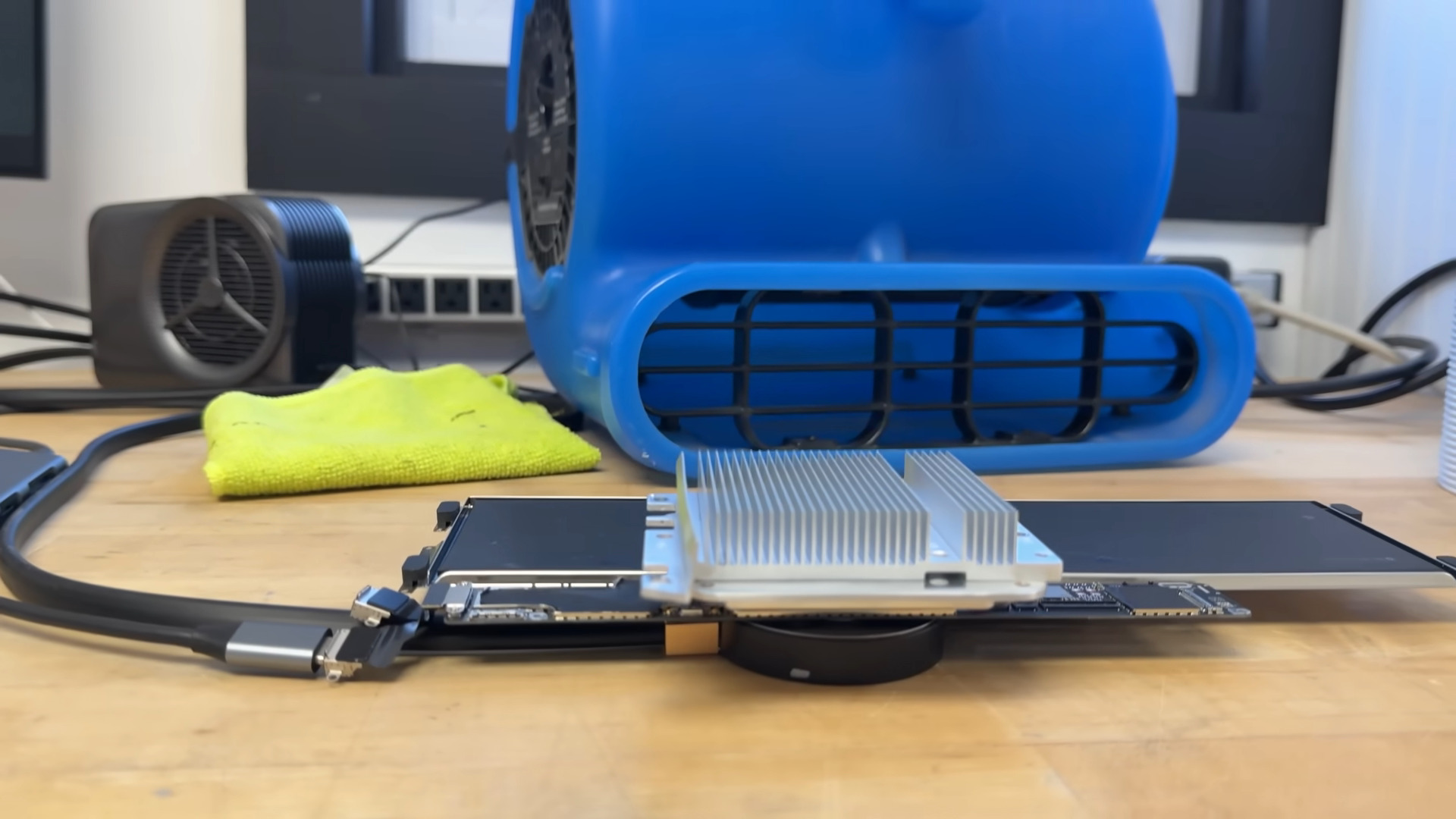
Salem Techsperts took cooling to another level, combining multiple advanced techniques. The foundation was PTM7950, a phase-change thermal paste that liquefies under heat, filling microscopic gaps for superior thermal transfer. On top of that, they added a Peltier cooler—a thermoelectric device that actively pumps heat away from the SoC. To dissipate this heat, they attached oversized heatsinks—likely weighing more than the laptop itself—and an industrial air blower capable of moving an enormous volume of air. The result was a cooling system that dwarfed anything found in a standard laptop.
The Frankenstein Setup
The logic board was removed from the original chassis and placed inside what can only be described as a 'cooling sandwich.' One side used water cooling paired with the Peltier element, while the other relied on the high-velocity air blower. This arrangement sacrificed all pretense of portability or practicality, but that was never the goal. The objective was pure, unadulterated speed.
Performance Gains: A Mixed Victory
The results were striking. In Cinebench, a benchmark that stresses the CPU, the modified MacBook Neo scored 41.47% higher than the stock version. Its power draw spiked to 11 watts—nearly three times the original 4 watts. However, the story didn't hold for graphics performance. Despite the CPU gains, the system could not beat the top 3DMark score. One likely explanation is the 'silicon lottery': every chip is slightly different, and this particular A18's GPU portion may have been less capable. Other theories include uneven cooling distribution or interface bottlenecks. The quest for the ultimate score continues.
Going Further: The Cryogenic Frontier
As impressive as this air-and-Peltier setup is, it doesn't approach the ultimate limit. For instance, in 2023, a Raspberry Pi 5 was overclocked to 3.6 GHz using liquid nitrogen cooling—a temperature far below freezing. The same principle applies here: if you can make the chip even colder, you can extract even more performance. The crown of 'fastest MacBook Neo' remains in the gutter, waiting for someone to risk condensation and cryogenic containers. At the time of writing, perhaps a new champion has already emerged. If so, we salute them—and encourage them to share their method.
Conclusion
Salem Techsperts' experiment proves that the MacBook Neo's A18 chip has substantial headroom for performance—if you're willing to abandon the laptop form factor. Through a combination of phase-change thermal paste, Peltier cooling, massive heatsinks, and industrial air blowers, they unlocked a 41% improvement in CPU benchmarks. While the GPU performance didn't follow suit, the journey highlights a classic principle: thermal management is the key to unlocking silicon's true potential. For those who dare to go even colder, the record is there for the taking.